AI-powered drawing review for every reissue.

Civoxel TrueSet compares every upload with the set before it: changed text marked, changed linework shown, same-revision changes flagged.

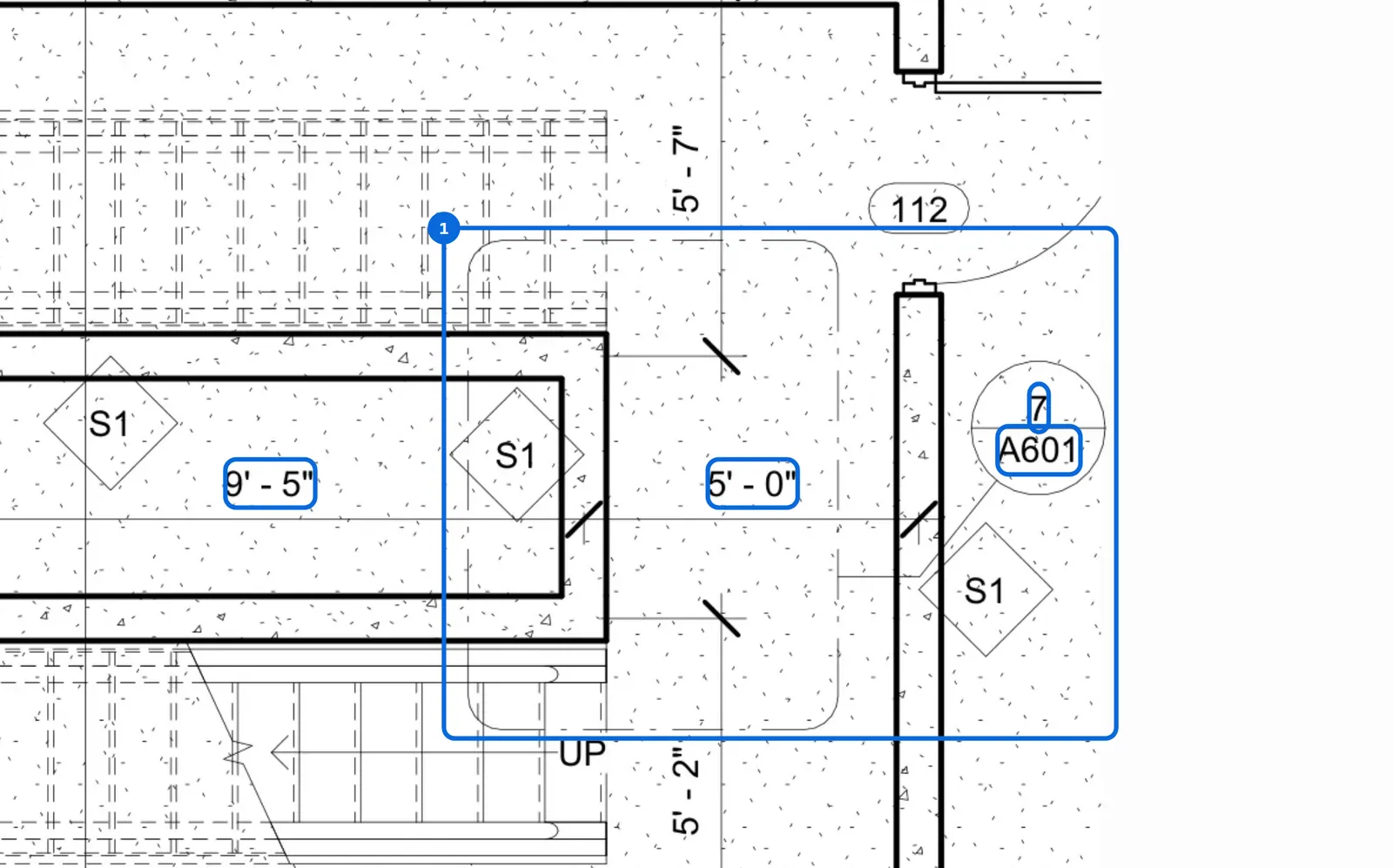
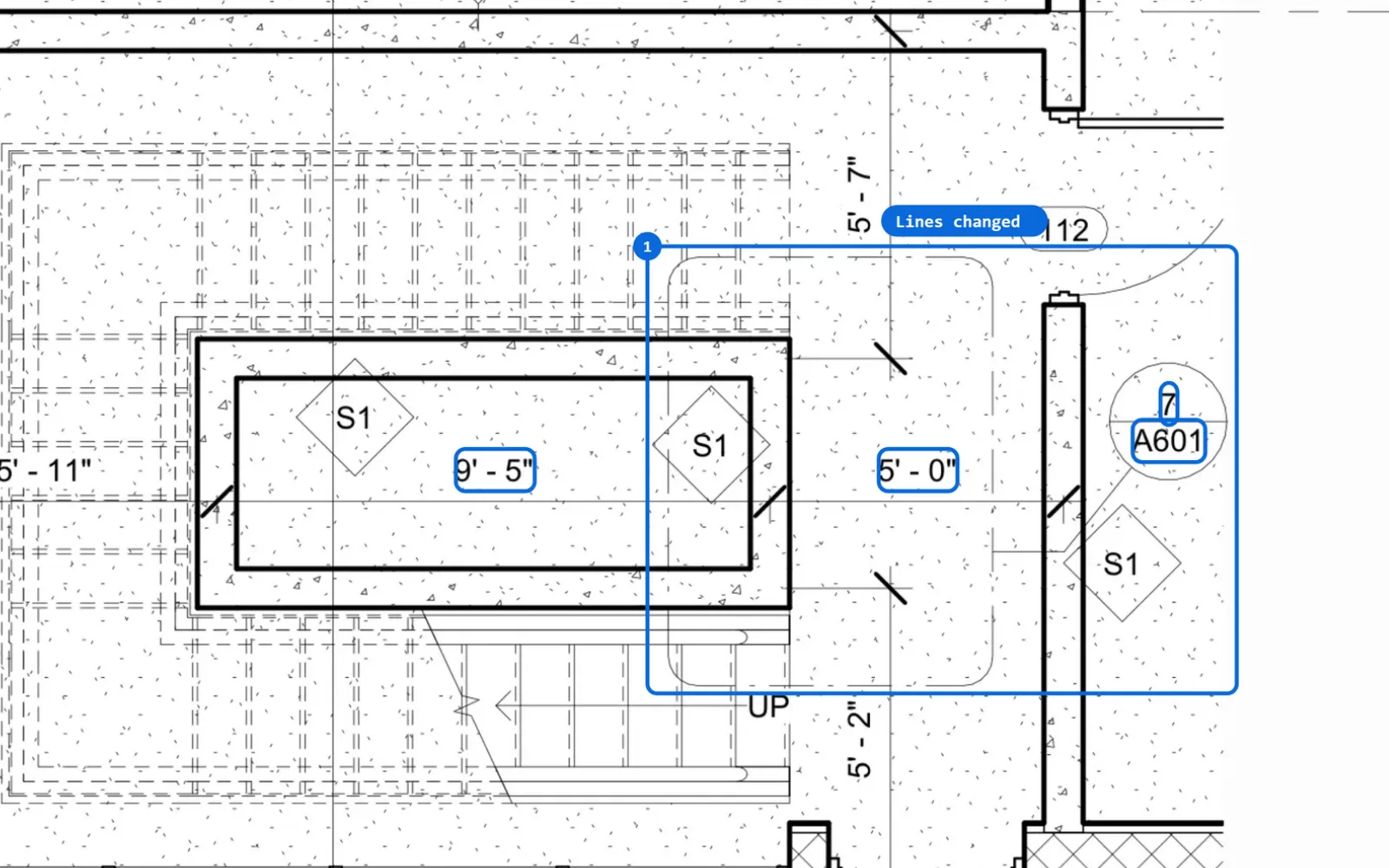
Sheet A501 at Rev 2, close up: the changed dimensions 9' - 5" and 5' - 0" and the new tag 7/A601 are boxed, and the place where the linework changed is boxed as 1.
Every finding shows its evidence. You decide.

From a revised set to an RFI draft

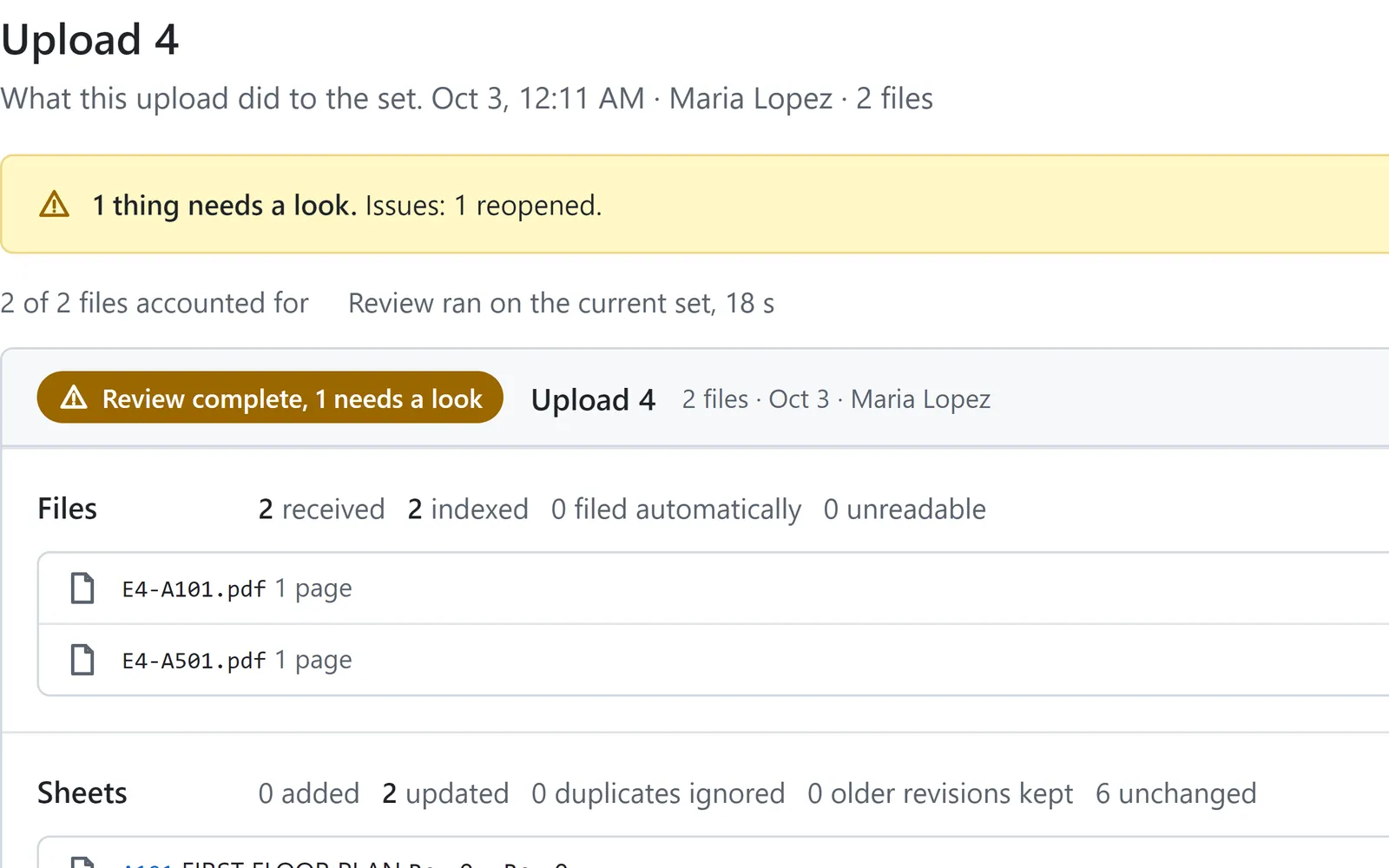
  1. Upload 4: 1 thing needs a look, 1 finding reopened; 2 of 2 files accounted for, 2 indexed.

    A revised set arrives

    Drop the reissued sheets. Every file is accounted for, and what needs a look is marked in amber.

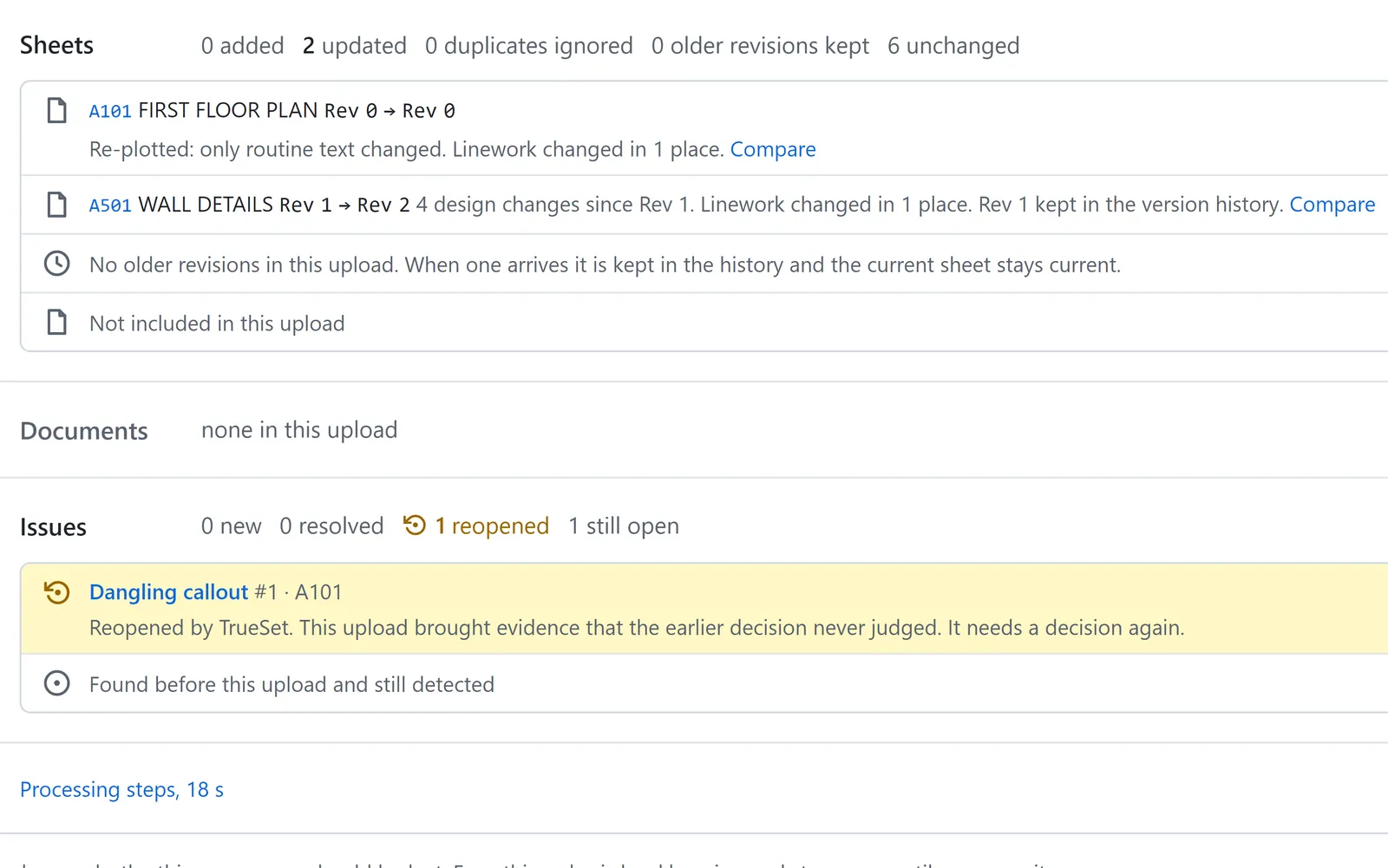
  2. The upload's sheets: A101 Rev 0 to Rev 0, re-plotted, linework changed in 1 place; A501 Rev 1 to Rev 2, 4 design changes since Rev 1.

    Compared with the set before

    Each reissued sheet is compared with the version it replaces, and the upload says what changed.

  3. A501 at Rev 2 with the changed dimensions and the new 7/A601 tag boxed.

    Changed text, marked

    Dimensions, notes and callouts that changed are boxed on the sheet. Dates and revision rows are kept apart as routine.

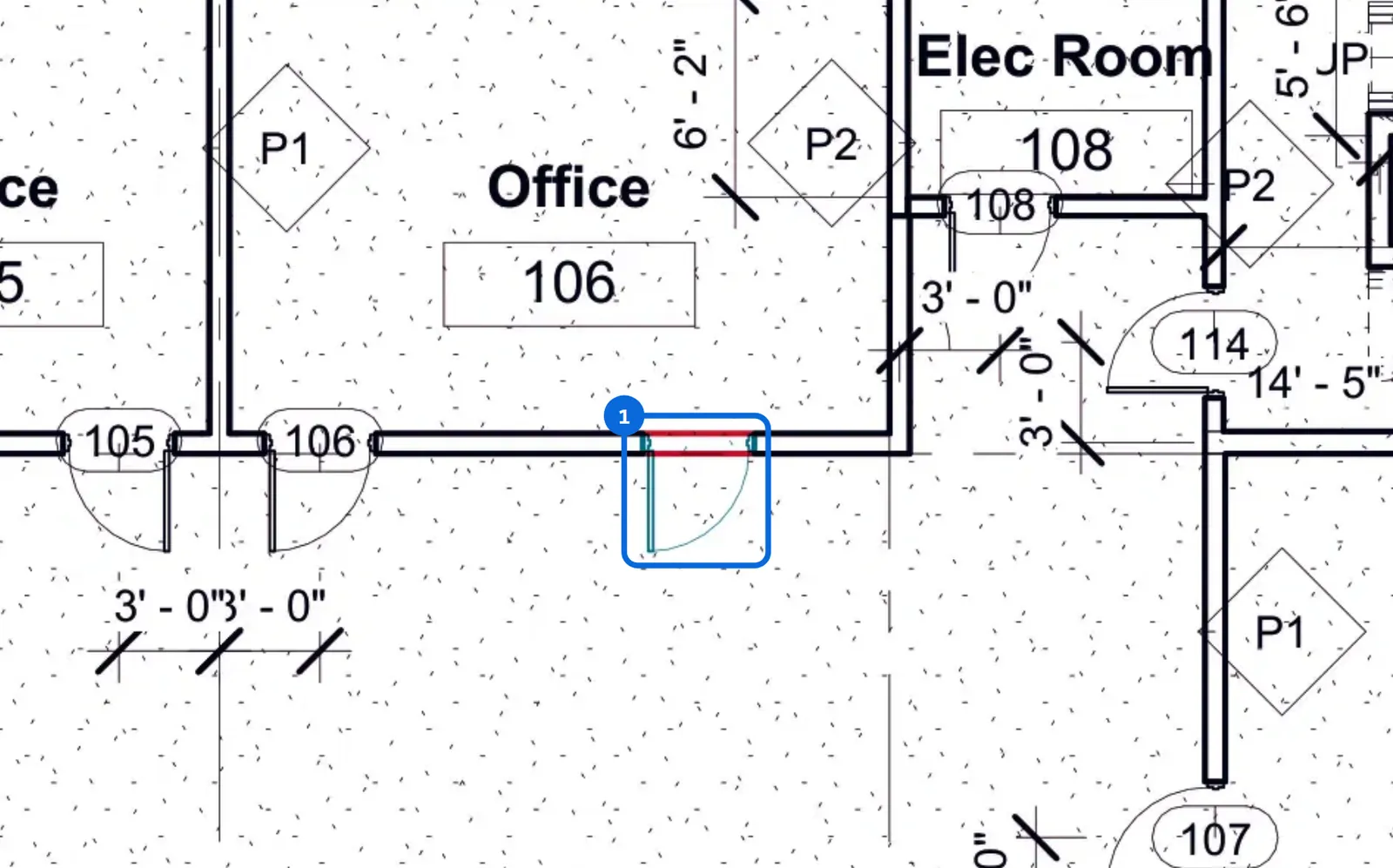
  4. Overlay of A101: the door added between Office 106 and the corridor, boxed as place 1.

    Overlay shows the linework that moved

    Red is only in the earlier version, cyan only in the later. A101 kept Rev 0, and Overlay still shows the door that was added.

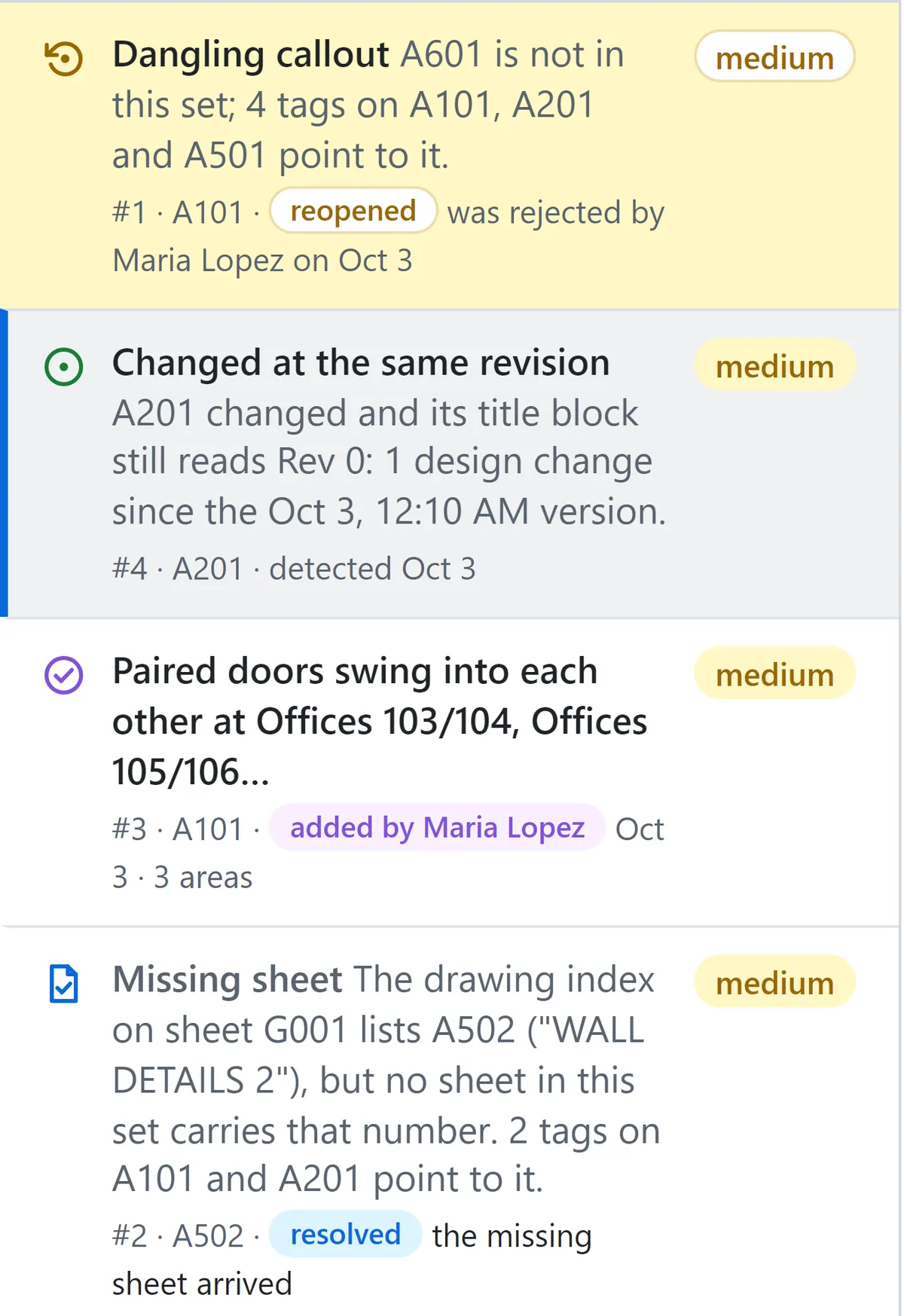
  5. The findings list: a dangling callout reopened by TrueSet, Changed at the same revision on A201, a person's finding, and a missing sheet resolved.

    What else it checks

    Missing sheets, dangling callouts, changes at the same revision, and six more checks on every upload.

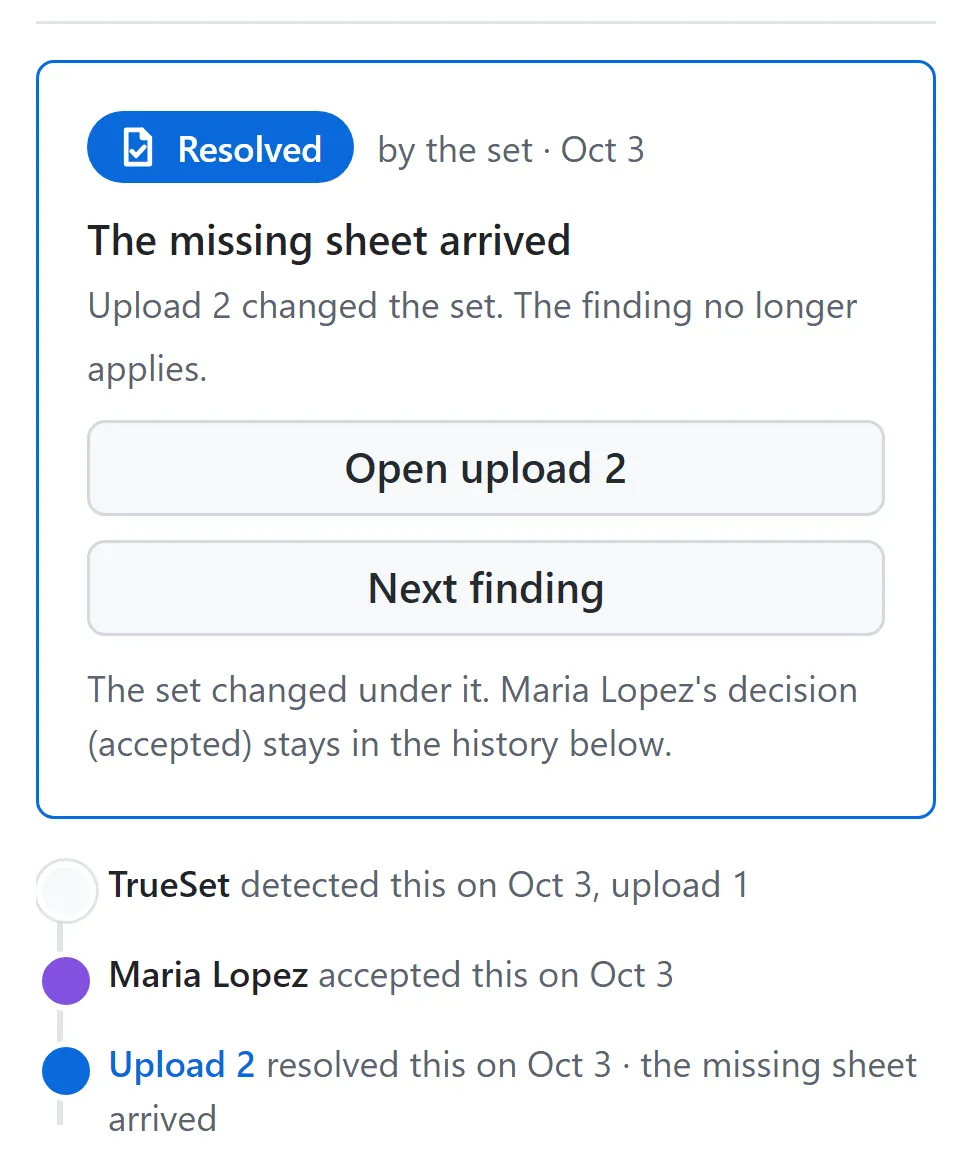
  6. Finding #2's history: TrueSet detected it in upload 1, Maria Lopez accepted it on Oct 3, and upload 2 resolved it when the missing sheet arrived.

    You decide

    Accept or reject each finding. Every decision is stamped with who and when, and stays on record.

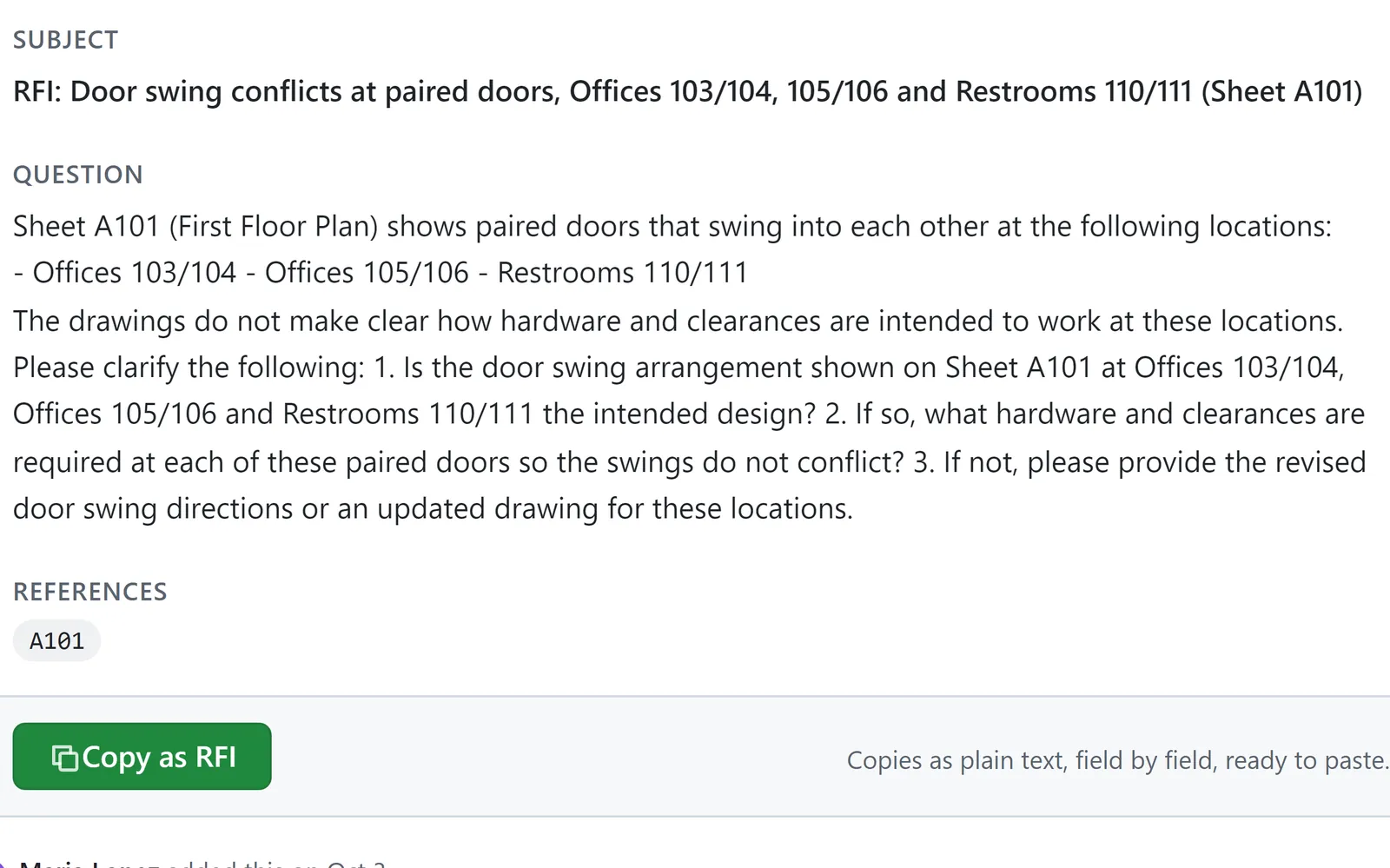
  7. An RFI draft from finding #3: the subject, the question and the cited sheet A101, with Copy as RFI.

    The RFI, drafted

    From an accepted finding, TrueSet drafts an RFI that cites the sheets involved. A draft, never sent for you.

Upload 4: 1 thing needs a look, 1 finding reopened; 2 of 2 files accounted for, 2 indexed. The upload's sheets: A101 Rev 0 to Rev 0, re-plotted, linework changed in 1 place; A501 Rev 1 to Rev 2, 4 design changes since Rev 1. A501 at Rev 2 with the changed dimensions and the new 7/A601 tag boxed. Overlay of A101: the door added between Office 106 and the corridor, boxed as place 1. The findings list: a dangling callout reopened by TrueSet, Changed at the same revision on A201, a person's finding, and a missing sheet resolved. Finding #2's history: TrueSet detected it in upload 1, Maria Lopez accepted it on Oct 3, and upload 2 resolved it when the missing sheet arrived. An RFI draft from finding #3: the subject, the question and the cited sheet A101, with Copy as RFI.

About 3 seconds a sheet on a first upload

45 sheets in under 3 minutes on our sample set, in production

Up to 512 MB a zip about 850 sheets of a typical set

Where your drawings go

Hosted in the United States. Never used for training. Deleted when the pilot ends, and the deletion is checked again after it runs.

Where your data goes Your browser sends your files straight to file storage, Cloudflare in Eastern North America, over signed links, and talks to TrueSet on Google Cloud in Northern Virginia. TrueSet reads the files and keeps what it makes there, and writes findings to the database, Supabase in Northern Virginia. Only when a question needs one, part of a document goes to OpenAI or Anthropic over paid APIs that do not train on it. Everything is deleted at pilot end. Your browseryour team, signed in TrueSetGoogle CloudNorthern Virginia FilesCloudflare, E. N. America DatabaseSupabase, N. Virginia ModelsOpenAI, Anthropicno training files, over signed links
  • Your set stays yours

    Processing is transient; your set is not, and that is the point — last week’s review has to still be there. Your files and everything TrueSet makes from them live in one place reserved for your project, shared with no one, and the whole of it is deleted when the pilot ends.

  • Hosted in the United States

    Processing and storage run on US infrastructure.

  • Never used for training

    Your files are processed through commercial AI APIs under terms that prohibit training on customer inputs. Nothing you upload trains a model, ours or anyone else's.

  • Deleted at pilot end

    When a pilot ends, your project data is deleted — within 7 business days, or immediately on request.

  • A human decides every finding

    TrueSet proposes. A person accepts or rejects, and nothing is submitted on your behalf.

  • Full audit trail

    Every decision is stamped with who and when, and every RFI draft traces back to its finding.

  • Sign-in

    Your people sign in with their work email and a 6-digit code — no passwords, no shared link. Your admins decide who is in, and as what: admin, member or read-only.

Questions we hear first

Do we have to replace Procore?
No. TrueSet works alongside the systems you already use. An RFI draft copies out as plain text, ready to paste into Procore, ACC or email, and nothing is sent from TrueSet.
Is our data safe? Is it used to train AI?
Processing and storage run on US infrastructure. Your files are processed through commercial AI APIs under terms that prohibit training on customer inputs. Nothing you upload trains a model, ours or anyone else’s. When a pilot ends, your project data is deleted — within 7 business days, or immediately on request. The deletion is checked again after it runs, and that record is yours on request.
How long does it take to get started?
No install, no integration, nothing to learn first. Sign in with your work email, drop the set’s zip, and the findings come back in minutes: our 45-sheet sample set took under 3 minutes in production.